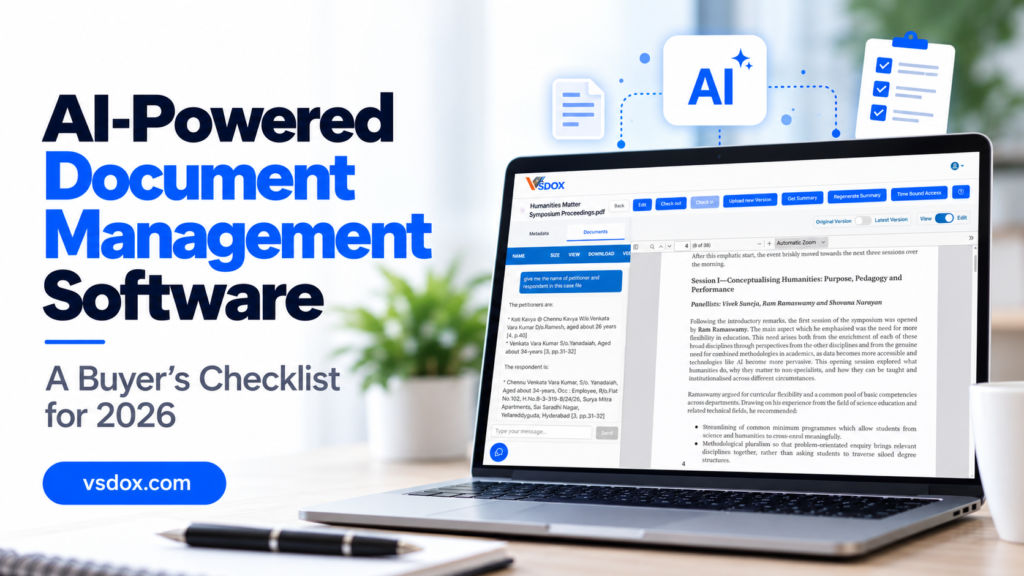

AI-powered document management software has become crowded enough with similar-sounding marketing claims that buyers need a structured checklist to cut through it, rather than comparing feature lists that mostly say the same thing in different words. This checklist walks through what actually differentiates AI-powered platforms in practice, organized as questions to ask during evaluation rather than capabilities to take at face value. This checklist deliberately avoids ranking specific vendors or naming particular platforms — it’s built to be applied to any AI-powered document management software you’re evaluating, VSDox included, as a consistent standard rather than a one-sided comparison.
Does It Solve a Specific, High-Volume Problem You Already Have?
AI capability delivers the clearest value against a specific, repetitive, high-volume document process — invoice processing, contract date extraction, onboarding form handling — rather than as a general-purpose add-on. Before evaluating any platform’s AI features, identify your own highest-volume, most repetitive document task, since that’s where AI-powered automation will actually be measurable, rather than treating AI as a checkbox feature to have regardless of fit.
If your organization doesn’t have a clear, high-volume repetitive document process today, AI capability may deliver comparatively little near-term value regardless of how well-implemented it is elsewhere — a useful, honest check before letting AI features drive the evaluation ahead of more fundamental document management needs.
It’s worth revisiting this question again after narrowing to a shortlist of two or three platforms, since the answer sometimes shifts once deeper technical conversations reveal automation potential in a process that didn’t initially seem like an obvious fit.
This identification exercise is worth doing formally with actual volume numbers rather than a general impression — a process that feels high-volume anecdotally sometimes turns out to be more modest once actually measured, and vice versa.
Can You Test Accuracy Against Your Own Documents Before Buying?
Any vendor confident in their AI capability should support a trial using a real, representative sample of your own documents, not just their demo dataset. Treat reluctance to run this test as a meaningful signal, and treat willingness to run it as one of the strongest positive indicators during evaluation — actual performance against your documents is worth more than any accuracy percentage quoted in a sales conversation.
Structure this test deliberately: include your most common document format, your messiest real-world examples, and a reasonable volume — a handful of hand-picked clean samples won’t reveal how the system performs once it’s processing your actual, unfiltered document stream.
It’s also worth running this same test again closer to final contract signing, not just during early evaluation, since platform performance and your own document mix can both shift over the course of a multi-month evaluation process.
What’s the Actual Exception Rate, and Who Handles It?
No AI document system runs with zero human oversight, and any implying otherwise is likely overstating current capability. Ask for a realistic exception rate — the percentage of documents that get flagged for human review — and confirm what that review workflow actually looks like inside the platform, since a high exception rate with no clear review workflow quietly shifts work back onto your team without anyone planning for it.
It’s worth asking specifically how the exception rate is expected to change over the first few months of use, and whether that expectation is based on the vendor’s actual customer data or a general assumption — the more specific and evidence-based the answer, the more confidence it warrants.
This question is worth asking not just once but at intervals after go-live, since a rising exception rate over time — rather than a stable or declining one — is a meaningful signal worth investigating rather than dismissing as normal variation.
Does AI Capability Integrate With the Rest of Your Document Workflow?
AI-powered classification and extraction deliver the most value when the resulting data flows directly into the same platform’s workflow, approval, and storage layers, rather than requiring a separate integration step to become usable. Ask specifically whether extracted data populates workflow fields automatically or whether it still requires manual transfer into another system.
A platform where AI extraction and document workflow are built as separate modules, bolted together rather than designed together from the start, often reveals friction at exactly this handoff point — worth testing directly during a demo rather than assuming based on a feature list that both capabilities exist.
It’s worth requesting a live walkthrough of this specific handoff — from extracted field to workflow trigger — during a demo, rather than accepting a description of the capability in the abstract.
It’s also worth asking specifically whether extracted data can trigger a workflow automatically — for instance, an extracted invoice amount above a certain threshold routing to a different, more senior approver — since this kind of conditional logic is where AI extraction and workflow automation genuinely compound each other’s value.
How Transparent Is the Vendor About Data Handling?
Where AI processing happens, how long extracted data is retained, and whether your documents contribute to training a model shared across other customers are legitimate security questions, not just technical footnotes. A vendor who answers these clearly and specifically is a stronger sign of platform maturity than one who deflects to general reassurance about security.
Request these answers in writing as part of the formal evaluation process, not just as a verbal assurance during a sales call — a vendor with genuinely strong data-handling practices should have no difficulty providing this in documented form.
This transparency question is also worth asking of any AI feature added to a platform after your initial evaluation, since new AI capabilities introduced later sometimes carry different data-handling practices than the ones reviewed during initial due diligence.
Finally, it’s worth checking whether the vendor’s data-handling documentation is versioned and dated, so that any future changes to their AI data practices are traceable rather than silently updated without customer notice.
How VSDox Fits
VSDox’s AI-powered document management capability is built to hold up against each item on this checklist directly — accuracy testable against your own documents before commitment, a defined and transparent exception-handling workflow rather than an implied fully-automated process, extracted data that flows directly into VSDox’s own workflow and approval system, and clear documentation on where AI processing happens. For organizations in BFSI, government, judiciary, and healthcare specifically, this transparency matters as much as the AI capability itself. Buyers are encouraged to walk through this checklist item by item during evaluation, using it as a working document to record each vendor’s specific answers rather than relying on general impressions formed during a sales conversation.
Explore VSDox’s AI-powered document management software.