
Quick Answer
If your teams are losing time searching for files, duplicating documents, or struggling with manual approvals, it’s a sign your organization has outgrown ad-hoc file storage. A digital document management system centralizes, secures, and automates this process.
Businesses today generate an enormous amount of information every day. From invoices and contracts to employee records, customer documents, purchase orders, compliance reports, and legal agreements, managing business information has become more complex than ever. As organizations grow, relying on paper files, shared drives, or scattered folders is no longer sustainable. These outdated methods often result in lost documents, security risks, inefficient workflows, and higher operational costs.
An Intelligent Digital Document Management System helps organizations overcome these challenges by transforming the way documents are captured, stored, organized, accessed, and managed. Instead of simply acting as a digital filing cabinet, modern document management solutions use Artificial Intelligence (AI), Optical Character Recognition (OCR), workflow automation, and advanced security controls to streamline business operations and improve decision-making.
Whether you are a small business planning for growth or a large enterprise managing millions of documents, investing in an intelligent Digital Document Management System is a strategic decision that improves efficiency, strengthens compliance, and supports long-term digital transformation.
What Is a Digital Document Management System?
A Digital Document Management System (DDMS) is a centralized software solution that enables businesses to securely store, organize, retrieve, manage, and share digital documents throughout their lifecycle.
Unlike traditional file storage systems, an intelligent Digital Document Management System goes beyond simple storage by offering features such as AI-powered search, document indexing, workflow automation, version control, audit trails, and role-based access permissions.
The objective is simple: ensure that every employee can find the right document instantly while maintaining complete control over document security, compliance, and collaboration.
Why Traditional Document Management No Longer Works
Many organizations still depend on manual processes and disconnected storage systems. As document volumes increase, these outdated methods create significant operational challenges.
Some of the most common problems include:
- Employees spending valuable time searching for files
- Duplicate or outdated document versions
- Poor collaboration across departments
- Lost or misplaced business records
- Security vulnerabilities
- Compliance risks
- Delayed approvals
- High paper storage and administrative costs
These issues not only reduce productivity but also affect customer experience, regulatory compliance, and business growth.
An intelligent Digital Document Management System eliminates these bottlenecks by providing a secure and organized environment where information is always available when needed.
Key Features of an Intelligent Digital Document Management System
Centralized Document Repository
Store all business documents in a secure digital repository where employees can easily access information without searching through multiple systems.
AI-Powered Document Search
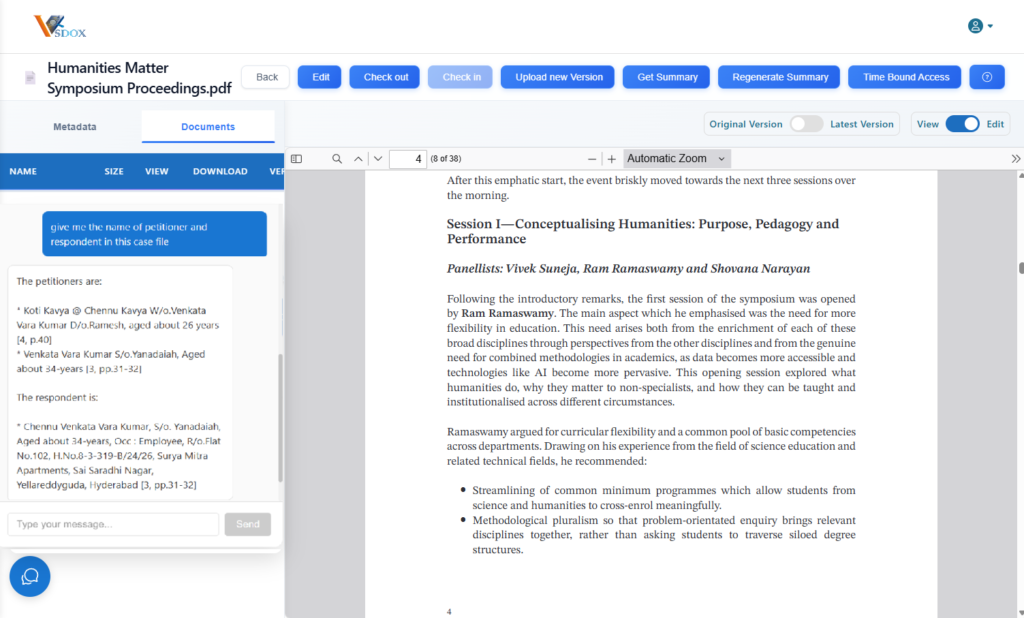
Modern systems use Artificial Intelligence to understand document content, metadata, keywords, and categories, allowing users to locate documents within seconds.
Optical Character Recognition (OCR)
OCR technology converts scanned paper documents into searchable digital files, making archived records accessible and easy to manage.
Intelligent Workflow Automation
Routine business processes such as invoice approvals, purchase requests, employee onboarding, and contract reviews can be automated, reducing manual effort and accelerating decision-making.
Version Control
Every document update is tracked automatically. Users always work with the latest version while previous versions remain securely archived for auditing and recovery.
Role-Based Access Control
Sensitive information is protected through user-specific permissions that ensure employees only access documents relevant to their responsibilities.
Audit Trails
Complete document activity is recorded, including viewing, editing, downloading, sharing, and approvals, helping organizations maintain transparency and accountability.
Cloud Accessibility
Authorized users can securely access documents from any location using desktops, laptops, tablets, or mobile devices, supporting today’s hybrid work environment.
Benefits of an Intelligent Digital Document Management System
Increased Productivity
Employees no longer waste time searching through emails or folders. Intelligent search and organized document structures allow teams to retrieve information quickly and focus on higher-value work.
Enhanced Collaboration
Departments can work together using a single source of truth. Documents remain synchronized, reducing confusion caused by duplicate copies or outdated files.
Improved Security
Business documents often contain confidential customer, employee, and financial information. Advanced encryption, access controls, authentication, and audit logs ensure sensitive data remains protected.
Regulatory Compliance
Organizations operating in regulated industries can simplify compliance by maintaining secure document retention policies, audit histories, and controlled access permissions.
Lower Operational Costs
Digitizing paper records reduces printing expenses, physical storage requirements, courier costs, and administrative overhead while improving overall efficiency.
Business Continuity
Cloud-based storage, automated backups, and disaster recovery capabilities ensure important business documents remain available even during unexpected events.
How AI Makes Document Management Smarter
Artificial Intelligence has transformed traditional document management into an intelligent business solution.
Modern AI-powered systems can:
- Automatically classify documents
- Extract important business data
- Generate document metadata
- Identify duplicate files
- Recommend workflow actions
- Improve search accuracy
- Analyze document content
- Accelerate invoice and contract processing
These capabilities reduce manual work while increasing speed, consistency, and accuracy across business operations.
Industries That Benefit from Digital Document Management Systems
Almost every industry manages large volumes of business documents. An intelligent Digital Document Management System provides measurable benefits across sectors including:
- Healthcare
- Banking and Financial Services
- Insurance
- Manufacturing
- Government
- Legal Services
- Education
- Real Estate
- Human Resources
- Construction
- Retail
- Logistics
Regardless of industry, businesses benefit from improved document accessibility, stronger security, and streamlined workflows.
Why VSDOX Is the Right Choice
VSDOX offers an AI-powered Enterprise Digital Document Management System designed to help organizations digitize, organize, secure, and automate business documents from a single platform.
Key capabilities include:
- Intelligent document indexing
- AI-powered search
- OCR-enabled document capture
- Secure centralized storage
- Workflow automation
- Version management
- Digital approvals
- Role-based access control
- Audit trails
- Cloud accessibility
- Enterprise-grade security
- Easy integration with existing business applications
Whether your organization manages thousands or millions of documents, VSDOX provides a scalable solution that supports operational efficiency, regulatory compliance, and digital transformation.
Best Practices for Successful Implementation
To maximize the value of a Digital Document Management System, organizations should follow these best practices:
- Create a structured document classification system.
- Standardize file naming conventions.
- Define user roles and permissions.
- Digitize legacy paper records using OCR.
- Automate repetitive workflows.
- Train employees on document management policies.
- Schedule regular backups.
- Monitor document activity using audit reports.
- Continuously review security and compliance settings.
These practices improve user adoption while ensuring long-term efficiency and governance.
The Future of Intelligent Document Management
As businesses continue embracing digital transformation, document management systems are becoming even more intelligent.
Future innovations include:
- AI-generated document summaries
- Voice-enabled document search
- Predictive workflow automation
- Intelligent compliance monitoring
- Automated document lifecycle management
- Advanced business analytics
- AI assistants for document retrieval
- Seamless integration with enterprise applications
Organizations that adopt intelligent Digital Document Management Systems today will be better prepared to compete in an increasingly data-driven business environment.
Conclusion
Managing business information efficiently is no longer optional—it is essential for growth, security, and operational excellence. An Intelligent Digital Document Management System empowers organizations to centralize documents, automate workflows, improve collaboration, strengthen security, and simplify regulatory compliance.
With AI-powered capabilities, cloud accessibility, and enterprise-grade security, VSDOX enables businesses to transform document management into a strategic advantage. Investing in a Digital Document Management System today helps organizations reduce costs, increase productivity, and build a future-ready digital workplace.
How do I know if my organization needs a document management system?
Common signs include employees spending significant time searching for files, duplicate or outdated documents in circulation, and manual, paper-based approval processes.
What happens if a business delays adopting a document management system?
Delaying adoption typically leads to rising storage costs, slower approvals, compliance risks, and lost productivity as document volume grows.
Is a digital document management system only for large enterprises?
No, organizations of any size can benefit once manual file handling starts affecting productivity or security.