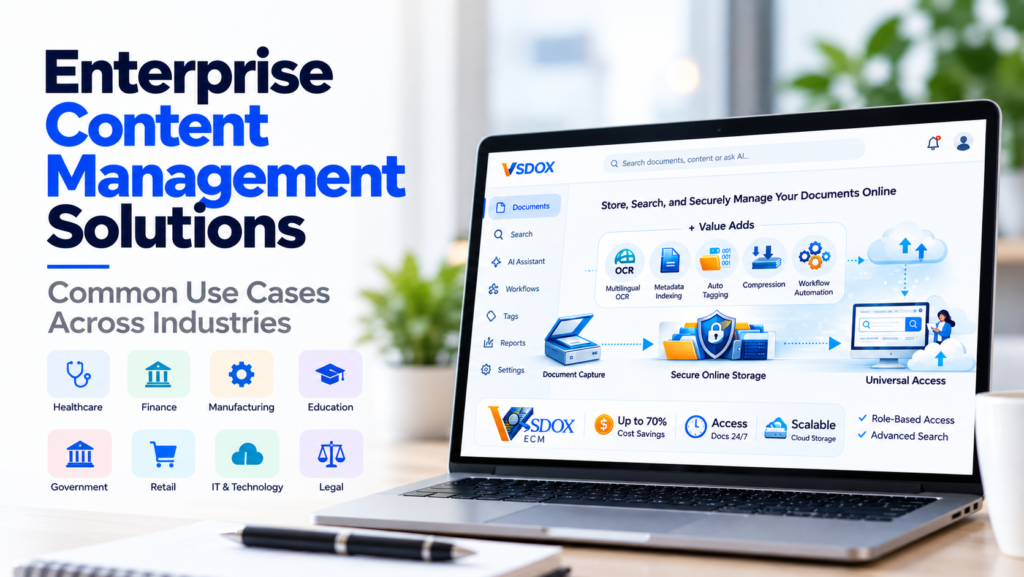

Enterprise content management solutions get evaluated very differently depending on which industry is asking, because the content that actually creates risk or friction looks completely different across sectors — a bank’s exposure is concentrated in transaction records and KYC documentation, while a hospital’s is concentrated in patient records and consent forms. This piece walks through how the same underlying ECM capability gets applied differently across the industries where it matters most, and why understanding your own industry’s specific use case matters more than a generic feature comparison. It’s also worth noting that many organizations actually span more than one of these use cases simultaneously — a hospital system with its own in-house legal team, or a bank with an internal training and compliance division, may need to support two or more of these governance models within the same overall ECM deployment.
Financial Services: Transaction Records and Regulatory Correspondence
In BFSI institutions, ECM solutions are most commonly applied to KYC documentation, loan files, and regulatory correspondence that must be retained for defined periods and produced quickly during an examination. The unstructured content risk here is significant — email correspondence with regulators or clients often carries as much compliance weight as formal transaction records, which is why financial institutions tend to need genuine content governance rather than document management alone.
This use case also typically demands the tightest audit-trail requirements of any industry covered here, since a regulator reviewing a financial institution’s records handling expects to see not just that a record exists, but a complete, defensible history of who accessed or modified it and when — a governance depth that goes well beyond simple document storage.
This is also the use case where the gap between a platform’s general security claims and its actual regulatory-specific capability tends to show up most clearly during evaluation — worth testing directly against your institution’s specific examination requirements rather than a general compliance checklist.
It’s also worth asking a financial-services-focused vendor directly how their platform has handled a past regulatory examination with an actual customer, since a concrete example carries more weight than a general capability claim.
Healthcare: Clinical and Administrative Records Together
Healthcare organizations use ECM solutions to unify clinical documentation, administrative paperwork, and scanned historical records under one governance framework, since patient information spans far more content types than a typical EHR alone manages. The access-control requirements here are unusually granular — the same case file often needs different visibility for clinical staff, billing staff, and external auditors, which is a content-governance challenge more than a simple document-storage one.
Retrieval speed also matters differently in this use case than in most others: a delay in administrative document retrieval is an inconvenience, but a delay in accessing clinical documentation during active patient care carries a different order of consequence entirely, which is part of why healthcare ECM deployments weight search performance so heavily during evaluation.
It’s worth noting that healthcare ECM evaluations often underweight this retrieval-speed requirement during initial vendor demos, since demo environments rarely simulate the document volume and concurrent-user load of a real clinical setting.
Legal and Judiciary: Case Files With Mixed Public and Restricted Content
Courts and legal institutions apply ECM specifically to manage case files that combine content requiring public accessibility with content that must remain sealed or restricted, often within the same case. This use case depends heavily on document-level (not just folder-level) access control, and on long, sometimes permanent retention requirements that differ meaningfully from typical corporate retention schedules.
Chain-of-custody logging is also a distinguishing requirement in this use case — an audit trail here isn’t just a compliance nicety but something that could itself become relevant if the integrity or timeline of a filing is ever challenged during proceedings, which raises the bar for how detailed and tamper-evident the logging needs to be.
This use case also benefits from involving court clerks directly in the evaluation process, since they’re the staff who will interact with the access-control model most frequently and can identify friction points a purely technical evaluation might miss.
This use case also tends to reveal the difference between a platform designed primarily for corporate document management and one built with judicial workflows specifically in mind — the tiered public/restricted access model rarely exists as a true first-class feature in general-purpose platforms.
Government: Public Records With Tiered Access Requirements
Government bodies use ECM to manage public records alongside internal administrative content, with access rules that shift depending on freedom-of-information obligations, ongoing investigations, or classification status. The common thread across government use cases is that access rules change over a record’s lifecycle — content that’s restricted during an active matter often needs to become publicly accessible once it’s resolved, which requires the governance layer to support scheduled access changes, not just static permissions.
This lifecycle-based access model is one of the more technically demanding use cases covered here, since it requires the system to track not just current permissions but future scheduled changes to those permissions, tied to milestones that aren’t always known precisely at the time a record is first filed.
Government deployments also tend to have unusually long procurement and evaluation cycles compared to other sectors, which is worth factoring into project timelines from the outset rather than treating a private-sector rollout timeline as the default expectation.
Manufacturing and Logistics: Quality and Compliance Documentation
In manufacturing, ECM solutions typically manage quality certificates, compliance documentation, and supplier correspondence tied to specific production batches or shipments. The distinguishing challenge here is document format variability — different suppliers submit paperwork in different layouts — which makes consistent metadata capture across a mixed-format content stream the primary technical hurdle.
This use case also tends to involve reconciliation as a core workflow, not just storage — matching delivery documentation against purchase orders and flagging discrepancies automatically, which reduces the manual cross-checking that otherwise falls on operations staff during routine reconciliation cycles.
Organizations in this sector should also weigh how well a platform handles multi-language or regional-format documentation, since manufacturing supply chains frequently span multiple states or countries with different paperwork conventions.
Organizations sourcing across a large, geographically distributed supplier base tend to see the clearest return on this reconciliation capability, since the volume and variability of incoming paperwork scales directly with the number of active supplier relationships.
How VSDox Fits
VSDox supports each of these use cases through the same underlying architecture — document-level access control, configurable retention by content type, and OCR-based capture for variable-format incoming documents — configured differently depending on which industry’s specific governance model applies. For organizations in BFSI, government, judiciary, and healthcare specifically, this configurability means the platform adapts to the industry’s existing content risk profile rather than forcing a generic governance model onto a use case it wasn’t built for. This same configurability also supports organizations that span more than one use case internally, since the underlying platform doesn’t require choosing a single industry template upfront — governance rules can be applied differently by department within one deployment.
Explore VSDox’s enterprise content management solutions.