
AI document management software is one of the most overstated categories in enterprise software right now, and the gap between what a vendor claims during a sales call and what actually works reliably on real documents can be significant. This guide is built around specific, testable questions a buyer can ask — and things a buyer can request to see directly — rather than accepting AI capability claims on faith, since the term “AI-powered” alone tells you almost nothing about what a platform actually does. None of the questions below require deep technical expertise to ask — they’re framed specifically so a business buyer, not just a technical evaluator, can push past marketing language and get a concrete, verifiable answer.
Ask for Accuracy Numbers Specific to Your Document Type
A vendor’s general “95% accuracy” claim is close to meaningless without knowing which document type and which dataset produced that number — accuracy on clean, standardized invoices doesn’t predict accuracy on varied, scanned forms from multiple sources. Ask directly for accuracy figures on the specific document type you’d actually be processing, and push for a test against a sample of your own real documents rather than the vendor’s polished benchmark set.
It’s also worth asking how that accuracy figure was calculated — whether it counts a field as correct only if extracted with zero errors, or applies a more forgiving standard. Two vendors quoting the same headline number can be measuring meaningfully different things underneath it.
It’s also reasonable to ask whether the accuracy figure reflects performance across an entire document, or only the specific fields most commonly extracted — a platform can report strong overall accuracy while performing considerably worse on the one field your process actually depends on most.
For document types with especially high variability — handwritten forms, for instance — it’s reasonable to expect noticeably lower accuracy than for standardized printed documents, and a vendor who quotes identical accuracy across wildly different document types deserves particular scrutiny.
Ask What Happens to Low-Confidence Extractions
Every AI extraction system has a confidence threshold below which it should flag a document for human review rather than guessing. Ask specifically what that threshold is, how it’s set, and what the actual workflow looks like when a document falls below it. A vendor who can’t answer this clearly, or who implies the system is close to fully automated with no meaningful exception rate, is likely overstating current AI capability.
The realistic expectation across the industry right now is significant automation with a genuine, ongoing exception rate — not full automation. A vendor who presents a near-zero exception rate as standard, rather than as an exceptional result for a narrow, highly standardized document type, deserves closer scrutiny.
This is also worth revisiting periodically after go-live, not just during initial evaluation — a platform’s exception rate creeping upward over time, without explanation, is worth raising directly with the vendor rather than assumed to be normal drift.
Ask Whether the Model Improves With Your Data, and What That Actually Means
Some platforms genuinely improve classification and extraction accuracy as they process more of an organization’s specific document formats; others use a static, pre-trained model that doesn’t meaningfully adapt. Ask which applies, and if the vendor claims the former, ask for a concrete example of measured accuracy improvement over a specific time period with a specific customer, not just the general claim that it happens.
This distinction matters directly for budgeting expectations: if a platform genuinely improves over time, an organization should expect a calibration period with a higher initial exception rate that decreases — which is a very different rollout expectation than a static model that performs at roughly the same level from day one.
Vendors sometimes describe this improvement in general terms — “the model gets smarter over time” — without specifying what data drives that improvement or how a customer’s own documents contribute to it, which is worth pressing on directly rather than accepting the general framing.
Ask Where Document Data Is Processed and Whether It Trains Other Customers’ Models
This is a data-privacy question that’s easy to overlook because it’s framed as a technical detail rather than a security one. Ask directly where AI processing happens, how long extracted data is retained by the AI component specifically, and whether your documents are used to improve a model shared across other customers. For organizations handling sensitive data, this deserves the same scrutiny as any other data-processing question — the “AI” label doesn’t exempt it.
A vendor with a mature, well-governed AI feature should be able to answer this precisely and in writing, not just verbally during a sales call — request the answer as part of the formal evaluation documentation rather than accepting an informal assurance.
This question also matters for internal stakeholder sign-off — a security or legal team asked to approve a new AI-powered tool will very likely ask exactly this question, so having a clear, written answer ready in advance shortens the internal approval process considerably.
Request a Live Test, Not a Recorded Demo
The single most reliable way to evaluate an AI document management claim is a live test against a batch of your own real, messy documents during the sales process — not a pre-recorded demo using the vendor’s curated dataset. A vendor confident in their actual capability should have no reluctance to run this test; hesitation here is itself useful information.
When running this test, deliberately include some of your organization’s messiest, least standardized documents alongside your cleanest examples — a platform that only performs well on the clean subset is telling you something important about how it will actually behave once it’s processing your full, real document volume.
It’s also reasonable to request this test be run without advance notice to the vendor’s implementation team about which specific documents will be used, since a test the vendor has had time to prepare for specifically doesn’t reveal as much as a genuinely representative sample.
It’s also reasonable to ask for this test to include a follow-up conversation reviewing the specific results together with the vendor’s technical team, rather than just receiving a summary report, since the reasoning behind specific errors often reveals more than the aggregate accuracy number alone.
How VSDox Fits
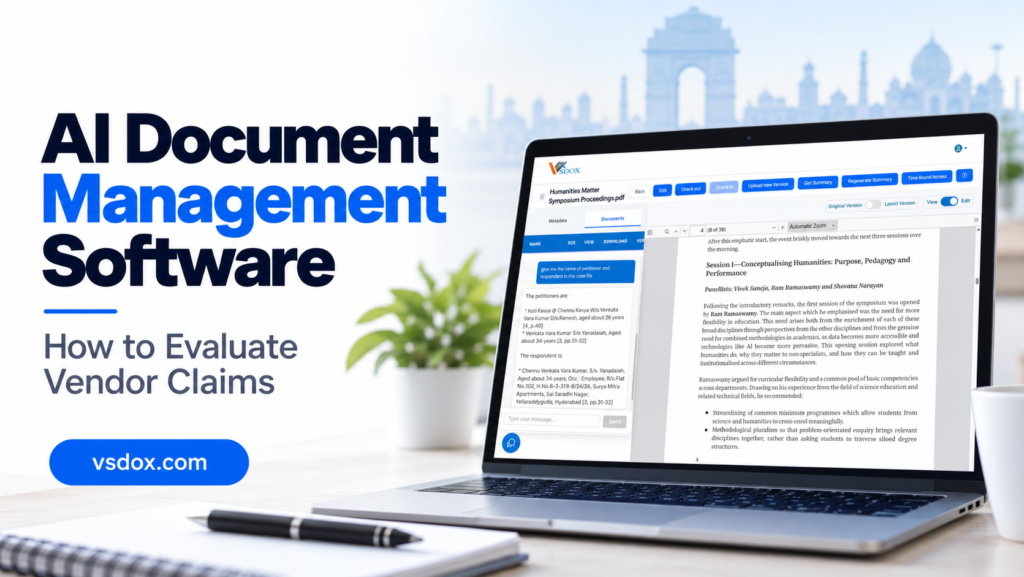
VSDox’s AI-assisted classification and extraction features are built to be tested this way directly — accuracy can be evaluated against a specific organization’s real document types before committing, low-confidence extractions are routed to human review by design rather than silently guessed, and the platform is transparent about where AI processing happens as part of its broader security documentation. Buyers evaluating VSDox specifically for AI capability are encouraged to request the same live test against their own documents described above, rather than relying on this article’s description of the feature. None of the questions in this guide are unusual or unreasonable to ask any serious AI document management vendor — a platform unwilling or unable to answer them clearly is telling you something important before you’ve even started the trial.
Explore: ai-powered document management software