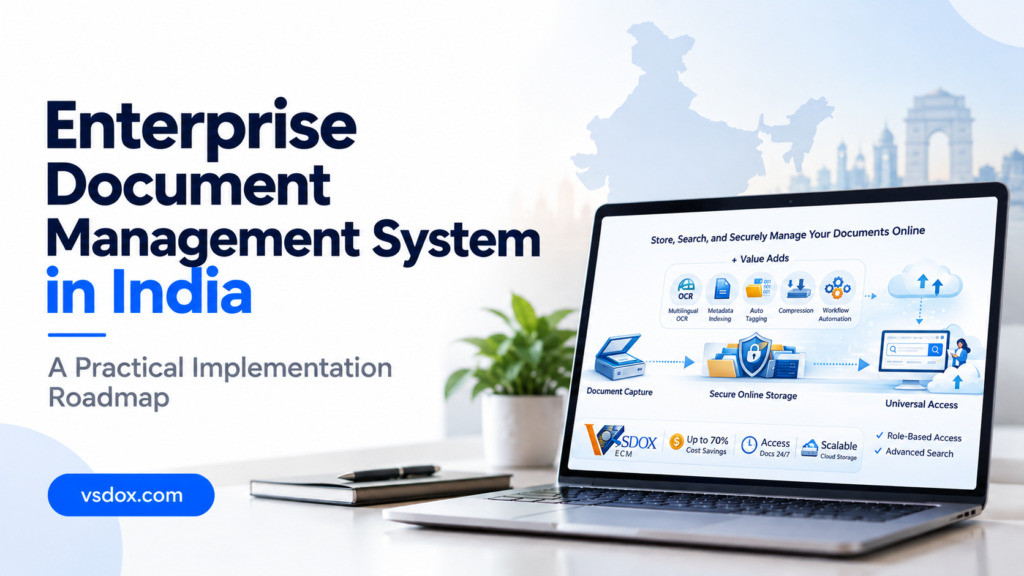

Enterprise document management system in India follows the same general sequencing that works anywhere, but with a few specific considerations that shape the rollout — data residency questions under the DPDP Act, integration with sector-specific systems, and often a wider range of technical familiarity across a distributed workforce. This roadmap walks through what an implementation actually looks like stage by stage in an Indian enterprise context, distinct from the general regulatory considerations covered elsewhere. For a deeper look at the specific regulatory frameworks referenced briefly here — the DPDP Act, CKYC, and GST record-keeping requirements — see our companion compliance-focused guide, which this piece intentionally doesn’t duplicate.
Stage 1: Confirm Data Residency and Hosting Requirements Early
Before selecting a deployment model, confirm whether your organization or sector has a specific data-residency requirement under the DPDP Act or sector-specific regulation that constrains where document data can be hosted. This should be resolved before vendor evaluation narrows the shortlist, since it can eliminate otherwise strong candidates immediately if their hosting model doesn’t fit — better to know this at the start than mid-negotiation.
This confirmation is worth getting in writing from a compliance professional rather than assumed from general familiarity with the regulation, since requirements can vary by sector and by the specific type of data involved — a financial institution and a general business may face meaningfully different obligations even under the same broad regulatory framework.
It’s also worth revisiting this confirmation periodically rather than treating it as settled permanently, since data-residency guidance in India has continued to evolve and a hosting decision made under earlier guidance may need reassessment.
Stage 2: Pilot in the Department With the Clearest Compliance Deadline
Indian enterprises often see the fastest internal buy-in when the pilot department is one facing an active, near-term compliance pressure — a KYC documentation backlog, an upcoming regulatory audit, or a GST record-keeping gap. Starting here gives the rollout a concrete, time-bound justification that’s easier to get budget and leadership attention for than a general efficiency argument.
This approach also tends to produce a more forgiving environment for the inevitable early friction of any new system rollout — when a department already understands why the change is happening and has a clear deadline in mind, minor early hiccups are more readily tolerated than they would be in a department implementing the system purely for general efficiency gains.
This pilot-department choice also tends to produce internal case-study material — a documented before-and-after result from a compliance-pressured department is often the most persuasive evidence available when seeking budget for the next phase of rollout.
It’s also worth identifying a second, slightly lower-priority department to follow immediately after the first pilot succeeds, so that early rollout momentum isn’t lost to a long gap between Stage 2’s pilot and the eventual wider expansion.
Stage 3: Plan for Mixed Technical Comfort Across Locations
Many Indian enterprises operate across head offices and branch locations with meaningfully different levels of day-to-day technical infrastructure and staff familiarity with cloud-based tools. Training and rollout pacing should account for this directly — a single training approach calibrated to head-office staff often underperforms significantly when applied unchanged to a branch office with less consistent technical support.
A practical approach is to pilot the rollout at a branch location specifically, not just at the head office, before finalizing the training materials for wider rollout — this surfaces gaps in the training approach earlier, when they’re cheaper to fix, rather than after training has already been delivered company-wide.
Branch-level piloting also surfaces connectivity and infrastructure gaps that a head-office-only pilot would never reveal, which matters directly for choosing a platform that performs acceptably on less consistent bandwidth.
Stage 4: Integrate With Existing Sector Systems Rather Than Replacing Them
Most Indian enterprises already run sector-specific systems — core banking platforms, hospital information systems, case management systems for judicial bodies — and a document management rollout works best when it integrates with these rather than asking staff to duplicate work across two systems. Confirming integration capability with your specific existing systems during evaluation avoids a rollout that technically succeeds but adds workload rather than removing it.
This confirmation should go beyond a general “yes, we integrate with that” from a vendor — request a specific technical description of how the integration works with your actual existing system and version, since integration claims that sound similar in a sales conversation can differ significantly in actual implementation depth.
This technical description request is also worth extending to a live test wherever possible — actually connecting to a sandbox or test instance of your existing system during evaluation reveals integration issues that a written description alone might not surface.
This stage is also a reasonable point to formally document the integration architecture for internal reference, since staff turnover in the IT team responsible for the original integration is common enough that undocumented integration knowledge is a real operational risk over a multi-year deployment.
Stage 5: Build in a Recurring Compliance Configuration Review
Indian regulatory guidance in areas like data protection and sector-specific record-keeping continues to evolve, so retention and access configurations set correctly at launch can drift out of alignment with current guidance over time. Scheduling a periodic — at minimum annual — review of the system’s compliance configuration against current regulatory guidance keeps the implementation from quietly becoming outdated after the initial rollout excitement fades.
Assigning this review to a specific role or team, with a calendar reminder rather than an informal intention to “check on it sometime,” is what actually makes this stage happen in practice — good intentions without a specific owner and date tend to quietly slip once the initial project team moves on to other priorities.
This review is also a reasonable moment to reassess whether the original pilot department’s success has actually translated to other departments as expected, making it a useful checkpoint for the rollout’s overall health, not just its compliance configuration specifically.
This periodic review is also a natural opportunity to reassess vendor-side compliance commitments — confirming that VSDox or any platform’s own certifications and data-handling practices remain current against the latest guidance, rather than relying on assurances given at the original point of purchase.
How VSDox Fits
VSDox is built with Indian enterprise deployment specifically in mind — cloud-first hosting with configurable data handling, integration capability aimed at the sector-specific systems common across Indian BFSI, government, judiciary, and healthcare institutions, and an implementation model designed for phased rollout across head-office and branch locations with varying technical infrastructure. Organizations planning a rollout across multiple Indian states or union territories are encouraged to confirm these considerations directly with VSDox’s implementation team, since specific requirements can vary by location and sector in ways a general roadmap can’t fully anticipate.