
What Is an Enterprise Content Management System (ECM)? A Complete Guide for Modern Businesses
In today’s digital economy, businesses create and manage enormous volumes of information every day. Emails, invoices, contracts, customer records, HR files, reports, scanned documents, multimedia files, compliance records, and business communications are constantly generated across departments. As organizations grow, managing this information efficiently becomes increasingly challenging.
When business content is scattered across multiple systems, shared drives, cloud storage platforms, and paper files, employees struggle to locate information quickly. This leads to wasted time, duplicated work, security risks, compliance issues, and slower decision-making.
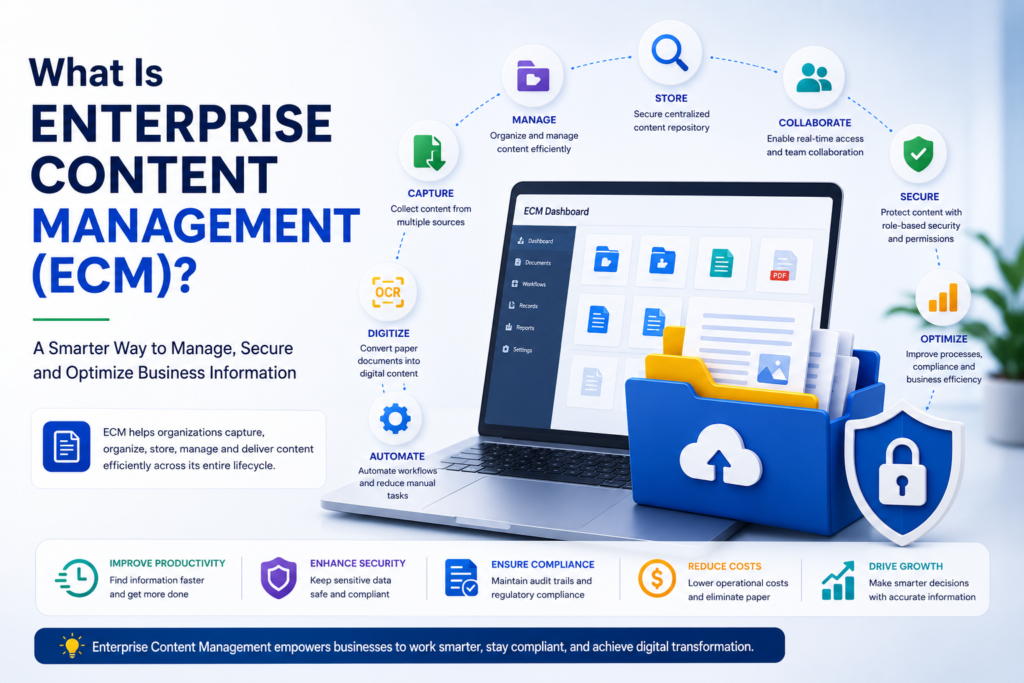
An Enterprise Content Management System (ECM) solves these challenges by providing a centralized platform that captures, organizes, stores, manages, secures, and delivers business content throughout its lifecycle. Modern ECM solutions go far beyond document storage by incorporating Artificial Intelligence (AI), workflow automation, Optical Character Recognition (OCR), intelligent search, and advanced security features to help organizations improve productivity and accelerate digital transformation.
Whether you’re a small business planning for growth or a large enterprise managing millions of records, an Enterprise Content Management System provides the foundation for efficient, secure, and intelligent information management.
What Is an Enterprise Content Management System?
An Enterprise Content Management System (ECM) is a software platform designed to manage all types of business content throughout its lifecycle—from creation and capture to storage, retrieval, collaboration, archival, and secure disposal.
Unlike a basic file storage solution, ECM manages both structured and unstructured information, including:
- Business documents
- Contracts
- Emails
- Images
- Videos
- PDFs
- Scanned files
- Employee records
- Customer documents
- Financial reports
- Compliance records
- Digital forms
The primary objective of an Enterprise Content Management System is to ensure that business information is organized, secure, searchable, and easily accessible while supporting collaboration, governance, and regulatory compliance.
Why Businesses Need Enterprise Content Management
As organizations expand, information grows rapidly across multiple departments. Without a centralized content management strategy, businesses often experience:
- Difficulty finding important documents
- Duplicate content across departments
- Manual document approval processes
- Security vulnerabilities
- Compliance challenges
- Poor collaboration
- Increased paper dependency
- Higher operational costs
- Slow customer response times
These issues reduce employee productivity and make it difficult to scale operations efficiently.
An Enterprise Content Management System addresses these challenges by creating a single source of truth where employees can securely access business information from anywhere.
How Does an Enterprise Content Management System Work?
An Enterprise Content Management System manages business information through several integrated stages.
- Content Capture
The system collects information from multiple sources including:
- Paper documents
- Scanned files
- Emails
- Mobile devices
- Business applications
- Digital forms
- Cloud storage
OCR technology converts paper documents into searchable digital files.
- Intelligent Organization
AI automatically categorizes documents using metadata, keywords, document types, customer names, project information, or business rules.
This makes content easier to organize and retrieve.
- Secure Storage
All content is stored within a centralized repository protected through encryption, role-based permissions, and backup mechanisms.
- Search and Retrieval
Employees can instantly locate information using:
- Keywords
- Document content
- Metadata
- Customer names
- Invoice numbers
- Dates
- Tags
AI-powered search dramatically reduces document retrieval time.
- Collaboration
Authorized users can review, edit, approve, and share content while maintaining complete version control.
- Archiving and Retention
Documents are automatically archived according to business policies while maintaining regulatory compliance.
Key Features of an Enterprise Content Management System
Centralized Content Repository
Store all business content within one secure platform instead of multiple disconnected systems.
AI-Powered Search
Locate business information instantly using intelligent search capabilities that understand document context.
OCR Document Capture
Convert scanned files into searchable digital documents while reducing manual data entry.
Workflow Automation
Automate repetitive processes such as:
- Invoice approvals
- Employee onboarding
- Purchase requests
- Contract reviews
- Compliance approvals
Automation improves efficiency while reducing errors.
Version Control
Maintain document history while ensuring employees always access the latest approved version.
Role-Based Access Control
Protect confidential information by controlling access based on departments, job roles, or user permissions.
Audit Trails
Track every document activity including creation, editing, downloads, approvals, and sharing.
Cloud Accessibility
Enable secure access to business content from anywhere while supporting remote and hybrid work environments.
Benefits of an Enterprise Content Management System
Improved Productivity
Employees spend less time searching for information and more time completing valuable business tasks.
Faster Decision-Making
Business leaders gain instant access to accurate information, allowing quicker approvals and better decisions.
Better Collaboration
Teams across departments can collaborate using the same documents without duplicate versions.
Enhanced Security
Enterprise-grade encryption, authentication, audit logs, and access controls protect sensitive business information.
Regulatory Compliance
Retention policies, audit trails, and secure document management simplify compliance with industry regulations.
Reduced Costs
Digitization reduces paper storage, printing, courier services, and administrative expenses.
Business Continuity
Cloud storage, automated backups, and disaster recovery protect business-critical information.
AI Is Transforming Enterprise Content Management
Artificial Intelligence is making Enterprise Content Management smarter than ever.
Modern AI-powered ECM systems can:
- Automatically classify documents
- Generate intelligent metadata
- Extract invoice data
- Analyze contracts
- Detect duplicate documents
- Recommend workflows
- Improve search relevance
- Generate document summaries
- Predict document lifecycle actions
AI significantly reduces manual work while improving operational efficiency and accuracy.
Industries That Benefit from Enterprise Content Management
Organizations across industries rely on ECM to manage growing volumes of digital information.
Industries include:
- Banking and Financial Services
- Healthcare
- Insurance
- Manufacturing
- Government
- Legal Services
- Education
- Retail
- Construction
- Logistics
- Real Estate
- Human Resources
Every organization handling sensitive documents can improve efficiency and governance through Enterprise Content Management.
Enterprise Content Management vs Document Management System
Although these terms are often used interchangeably, they serve different purposes.
| Enterprise Content Management | Document Management System |
|---|---|
| Manages all business content | Primarily manages documents |
| Includes emails, videos, forms, records | Focuses on digital documents |
| Supports enterprise-wide workflows | Supports document workflows |
| Broader governance capabilities | Strong document organization |
| Enterprise collaboration | Document collaboration |
| Content lifecycle management | Document lifecycle management |
For growing organizations, ECM provides a comprehensive platform that manages all enterprise information rather than documents alone.
Why Choose VSDOX Enterprise Content Management System?
VSDOX delivers an AI-powered Enterprise Content Management System designed to help businesses centralize, organize, secure, and automate business content.
Key capabilities include:
- AI-powered content classification
- OCR-enabled document digitization
- Centralized enterprise repository
- Intelligent enterprise search
- Workflow automation
- Digital approval management
- Version control
- Role-based security
- Audit trails
- Cloud accessibility
- Enterprise-grade encryption
- Integration with ERP, CRM, HRMS, and business applications
Whether your organization manages thousands or millions of files, VSDOX provides a scalable ECM platform that improves productivity while supporting digital transformation initiatives.
Best Practices for Implementing an Enterprise Content Management System
To maximize return on investment:
- Define a clear content taxonomy.
- Create standardized naming conventions.
- Configure user roles and permissions.
- Digitize legacy paper records.
- Automate repetitive business workflows.
- Train employees on ECM policies.
- Schedule automated backups.
- Monitor audit reports regularly.
- Review compliance policies periodically.
Following these best practices improves user adoption and ensures long-term success.
The Future of Enterprise Content Management
Enterprise Content Management continues to evolve with Artificial Intelligence, cloud computing, automation, and advanced analytics.
Future innovations include:
- AI-generated document summaries
- Voice-enabled enterprise search
- Predictive workflow automation
- Intelligent compliance monitoring
- Automated content lifecycle management
- Business intelligence dashboards
- AI-powered virtual assistants
- Deeper integration with enterprise applications
Organizations adopting modern ECM platforms today will be better positioned to manage growing information volumes while improving agility and competitiveness.
Conclusion
Business information is one of an organization’s most valuable assets, but without the right system, it can quickly become difficult to manage. An Enterprise Content Management System helps businesses centralize content, automate workflows, improve collaboration, strengthen security, and simplify regulatory compliance.
With AI-powered capabilities, intelligent search, workflow automation, OCR, and enterprise-grade security, VSDOX enables organizations to transform how they manage business content. Investing in a modern Enterprise Content Management System not only streamlines daily operations but also provides a scalable foundation for long-term digital transformation and business growth.
Frequently Asked Questions (FAQ)
What is an Enterprise Content Management System?
An Enterprise Content Management System (ECM) is a software platform that captures, stores, organizes, manages, and secures business content such as documents, emails, images, records, and digital files throughout their lifecycle.
What is the difference between ECM and a Document Management System?
A Document Management System focuses mainly on managing documents, while an Enterprise Content Management System manages all types of enterprise content, including emails, records, multimedia files, forms, and documents.
What are the benefits of an Enterprise Content Management System?
Key benefits include improved productivity, enhanced security, faster document retrieval, workflow automation, regulatory compliance, better collaboration, and reduced operational costs.
How does AI improve Enterprise Content Management?
AI automates document classification, metadata extraction, intelligent search, workflow routing, contract analysis, and content organization, making information management faster and more accurate.