
| Quick Answer
A document management system for healthcare organizes clinical documentation, patient records, insurance paperwork, and compliance files in a single secure, searchable repository — built specifically around the access-control, retention, and interoperability requirements that healthcare data demands. Unlike a generic DMS, a healthcare-focused system needs to support fast medical record retrieval, integration with EHR/EMR platforms, and strict audit trails for every access to patient information. |
Why Healthcare Document Management Is Different
Most document management challenges come down to findability and control — but in a healthcare setting, both problems carry a different weight. A misfiled contract costs a business team an afternoon. A misfiled or slow-to-retrieve patient record can delay diagnosis, treatment, or a critical handoff between care teams. That difference in stakes is why healthcare organizations generally can’t get away with a generic file-sharing tool the way a smaller business sometimes can — the system has to be built around clinical urgency and regulatory obligation from the start, not retrofitted onto a general-purpose platform later.
The document types involved are also more varied than in most industries: clinical notes, lab results, imaging reports, discharge summaries, insurance authorizations, consent forms, and administrative records all need to coexist in the same system, often generated by different departments and different software, but frequently needed together for a single patient encounter.
Clinical Documentation Software: Core Requirements
Clinical documentation specifically refers to the records created during patient care — progress notes, treatment plans, physician orders, nursing documentation. Software built for this needs fast, reliable capture (often at the point of care, sometimes under time pressure), structured templates that keep documentation consistent across clinicians, and a clear version history, since clinical records are frequently amended and every amendment needs to be traceable rather than simply overwriting what came before.
Search matters differently here too. A billing clerk searching for an invoice can tolerate a few extra seconds. A clinician pulling up a patient’s history during a consultation generally can’t — which makes retrieval speed and search accuracy a clinical safety issue, not just a convenience feature.
Medical Record Retrieval: The Real Bottleneck
Slow record retrieval is one of the most common operational complaints in healthcare settings still relying on partially digitized or poorly indexed systems. The bottleneck usually isn’t storage capacity — it’s inconsistent metadata and fragmented systems, where a patient’s imaging lives in one platform, their lab results in another, and their intake paperwork in a scanned folder that isn’t linked to either. A proper document management layer solves this by giving every record consistent patient-linked metadata regardless of which department created it, so retrieval doesn’t depend on knowing which system to search first.
This also matters for administrative retrieval needs that have nothing to do with active care — responding to a records request, supporting an insurance claim, or producing documentation for an audit. These requests often come with tight legal deadlines, and a system that can’t retrieve a complete patient record quickly creates real compliance exposure, not just inconvenience.
Compliance and Data Privacy in Healthcare Document Management
Healthcare records carry some of the strictest data-privacy obligations of any document category, and the specific requirements vary by jurisdiction and institution type — hospitals, diagnostic labs, and insurers often sit under overlapping regulatory frameworks. At minimum, a healthcare document management system needs role-based access restricted to a genuine need-to-know basis, detailed audit logging of every view and edit (not just downloads), encryption at rest and in transit, and defined retention schedules that reflect how long different record types must legally be kept. Any specific compliance claim — what a platform actually supports for a given jurisdiction’s healthcare data-protection rules — should be confirmed directly with the vendor and, where relevant, a compliance professional, rather than assumed from general marketing language.
Interoperability: Connecting With EHR and EMR Systems
Very few healthcare organizations run a document management system in isolation — it usually needs to sit alongside an existing Electronic Health Record (EHR) or Electronic Medical Record (EMR) platform rather than replace it. The document management layer’s job is often to handle everything the EHR doesn’t natively manage well: scanned paper records, faxed referrals, signed consent forms, insurance correspondence, and administrative documentation. Integration quality — through APIs or established healthcare data standards — determines whether this feels like one connected system to clinical staff or two disconnected ones they have to check separately.
Training and Adoption Among Clinical Staff
A document management system in a healthcare setting only delivers value if clinical and administrative staff actually use it consistently, and adoption in this environment faces a specific challenge: clinicians are often under significant time pressure and have limited patience for a system that adds friction to already demanding workflows. Training needs to be brief, role-specific, and focused on the handful of actions a given user actually performs daily, rather than a comprehensive walkthrough of every feature. Involving a few respected clinicians as early adopters and internal champions tends to build trust in the system faster than a mandate from administration alone.
How VSDox Supports Healthcare Document Management
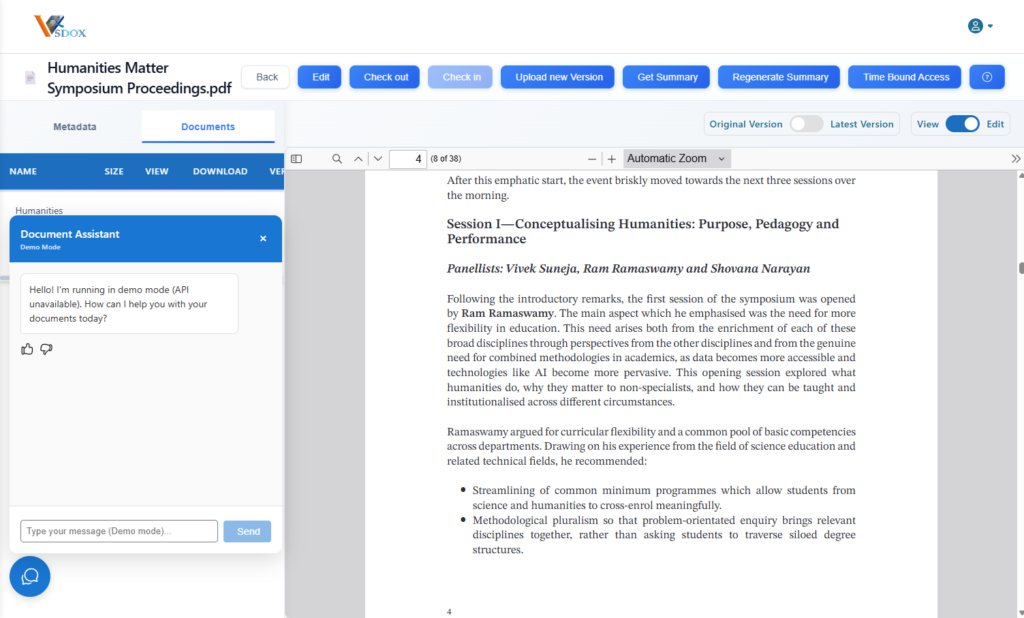
VSDox supports healthcare organizations with role-based access control down to the document level, detailed audit trails on every record access, configurable retention schedules by document type, and OCR-based capture for bringing scanned and faxed records into a searchable, patient-linked repository. This is positioned to complement an existing EHR/EMR system rather than replace it — handling the administrative and scanned-document layer that clinical systems typically aren’t built to manage well. As with any healthcare deployment, specific compliance capabilities should be confirmed directly against your institution’s regulatory requirements before rollout.
For institutions running multiple facilities or departments, VSDox’s centralized permission structure also allows administrative staff to manage access consistently across locations, rather than each facility maintaining its own separate, potentially inconsistent set of access rules for what should be the same underlying patient-record governance policy.
Frequently Asked Questions
What is the difference between an EHR and a document management system in healthcare?
An EHR (Electronic Health Record) is built specifically for clinical data — diagnoses, treatment history, medications. A document management system handles the broader range of documentation around care — scanned forms, consent paperwork, insurance correspondence, faxed referrals — often integrating with the EHR rather than replacing it.
Why is medical record retrieval speed so important?
Slow retrieval during active care can delay clinical decisions, and slow retrieval for administrative requests (audits, insurance claims, legal record requests) can create compliance exposure due to tight response deadlines.
What security features should a healthcare document management system have?
Role-based access control, detailed audit logging of every access (not just downloads), encryption at rest and in transit, and defined retention schedules by document type are the baseline expectations for handling healthcare data.
Can a document management system handle both clinical and administrative healthcare documents?
Yes — a well-designed system can manage clinical documentation, insurance paperwork, consent forms, and administrative records within one governed repository, typically linked by patient or case identifier for unified retrieval.
Does a healthcare document management system replace the need for an EHR?
No — it typically complements an EHR by handling document types and workflows the EHR isn’t built to manage, such as scanned paper records and administrative correspondence, rather than replacing clinical data management.