
Enterprise Content Management System: How ECM Differs From Document Management
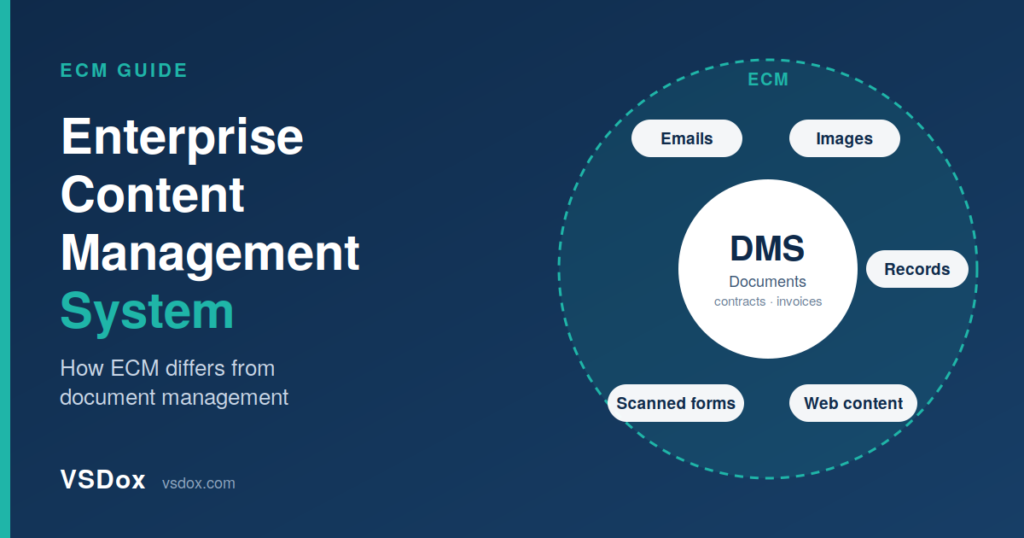
Quick Answer: An enterprise content management system (ECM) manages a broader range of content than a document management system (DMS). That includes emails, scanned images, web content, multimedia and structured records. It governs all of it across its full lifecycle, from creation through active use to archival or disposal, across the entire organization.
Enterprise Content Management System vs. DMS: Where the Line Actually Is
The terms get used almost interchangeably in casual conversation, but there is a real distinction. Document management is a subset of content management. A DMS is primarily concerned with discrete documents such as contracts, invoices and policies.
An enterprise content management system is built to manage content more broadly. It covers documents, but also emails, scanned records, images, web pages and other unstructured content, all under a single governance framework instead of separate silos. If you’re comparing options, our guide to enterprise content management software covers more of this topic.
The Content Lifecycle an ECM System Manages
An ECM platform is organized around the full lifecycle of content, not just storage:
- Capture brings content in from multiple channels: email, scanning, direct upload and web forms.
- Manage covers version control, workflow and collaboration while the content is actively in use.
- Preserve handles long-term archival for content that must be retained for legal or regulatory reasons.
- Deliver makes content available to the right audience, whether an internal team or an external customer portal.
- Dispose ensures content is properly deleted once its retention period ends, which matters as much for compliance as capture does.
Do You Need an Enterprise Content Management System or a DMS?
A useful diagnostic question is where your compliance or audit risk actually lives. Is it primarily in formal documents, or is it spread across email threads, scanned forms and other unstructured content too?
A law firm or financial services company, for example, often has as much regulatory exposure in email correspondence as in signed contracts. That is a strong signal that ECM-level governance, not just document management, is the right scope.
A simpler organization with mostly standardized document types and low email-based risk may find a well-configured DMS sufficient for a long time. Moving to a full enterprise content management system too early can add governance overhead without a real reduction in risk.
Why Organizations Move From DMS to ECM
The typical path starts with document management to solve an immediate, visible problem, usually contract or invoice chaos. Later, the organization realizes that emails, scanned forms and other unstructured content are creating the same problems in parallel systems that don’t talk to each other.
Moving to an ECM system consolidates that governance on one platform. It replaces separate tools that each have their own permission models and audit trails.
What to Evaluate in an ECM Platform Beyond Document Storage
When evaluating a system specifically as an enterprise content management system rather than a document tool, look at:
- How it handles email archiving
- Whether it can capture and index scanned images with OCR
- How it manages records with fixed retention requirements versus content that can be freely edited
- Whether it offers a records-management module distinct from general document storage
Compliance-driven retention and general business collaboration often need different rules applied to the same underlying content.
How ECM Governance Works Day to Day
In practice, ECM governance is a set of rules applied consistently regardless of content type or source. A retention rule doesn’t just apply to a formally filed document. It applies equally to an email thread archived into the system or a scanned form captured from a branch office.
That consistency is what makes an enterprise content management system defensible in a compliance review. The organization can show that the same rule applied everywhere the relevant content lived, instead of explaining why a policy was enforced in one system but not another.
It also changes how IT and compliance teams work together. Instead of compliance defining a policy that IT interprets separately across disconnected tools, both teams get a single place to define and audit it. That tends to reduce implementation effort and the risk of inconsistent enforcement.
VSDox as an Enterprise Content Management System
VSDox goes beyond basic document storage. It handles scanned records, email-linked documentation and structured retention policies within a single governed repository, which is what separates an ECM platform from a narrower DMS tool. You can see how it works on the VSDox enterprise content management system page.
Compared with EisenVault, which is also positioned around broader content and records management for Indian mid-market organizations, VSDox differentiates on ease of self-configuration. Departments can adjust their own workflows without routing every change through IT.
Two quick tests can help you decide whether you need a full ECM platform:
- Count your tools. How many separate systems hold business-critical content: a document system, a separate email archive, a scanned-forms folder? Each one is a governance gap an ECM platform is designed to close.
- Measure manual reconciliation. How much time does someone spend cross-checking that an archived email matches the contract it relates to? That work is a strong sign of the fragmentation ECM is meant to eliminate, and it often takes longer than it first appears once you actually measure it.
Frequently Asked Questions
Is an enterprise content management system the same as document management?
No. Document management is a subset of ECM. A DMS focuses on discrete documents, while an enterprise content management system governs a broader range of content, including emails, scanned images and multimedia, across its full lifecycle from creation to disposal.
What are the five stages of the ECM content lifecycle?
Capture, manage, preserve, deliver and dispose are the five commonly referenced stages. They cover how content enters the system, is used, is archived, is made available, and is eventually deleted.
Why would an organization need an enterprise content management system instead of just a DMS?
Organizations typically move to ECM when unstructured content like emails and scanned records creates the same governance and findability problems as documents, but in separate, disconnected systems.
Does an ECM system replace email archiving tools?
Some ECM platforms include email capture and archiving as a built-in module, which can reduce the need for a separate email-archiving tool, though this varies by vendor.
Is enterprise content management software only relevant to large enterprises?
The term originated in large-enterprise contexts, but mid-sized organizations with growing volumes of unstructured content, not just formal documents, increasingly benefit from ECM-style governance as well. Browse more in our enterprise content management software resources.